
Designing Passively in an Urban Environment
Lauren Thomsen Design defies notions that sustainable single-family building is impossible in cities, GHB awards the Northern Liberties Passive Rowhouse as our Urban Project of the Year.
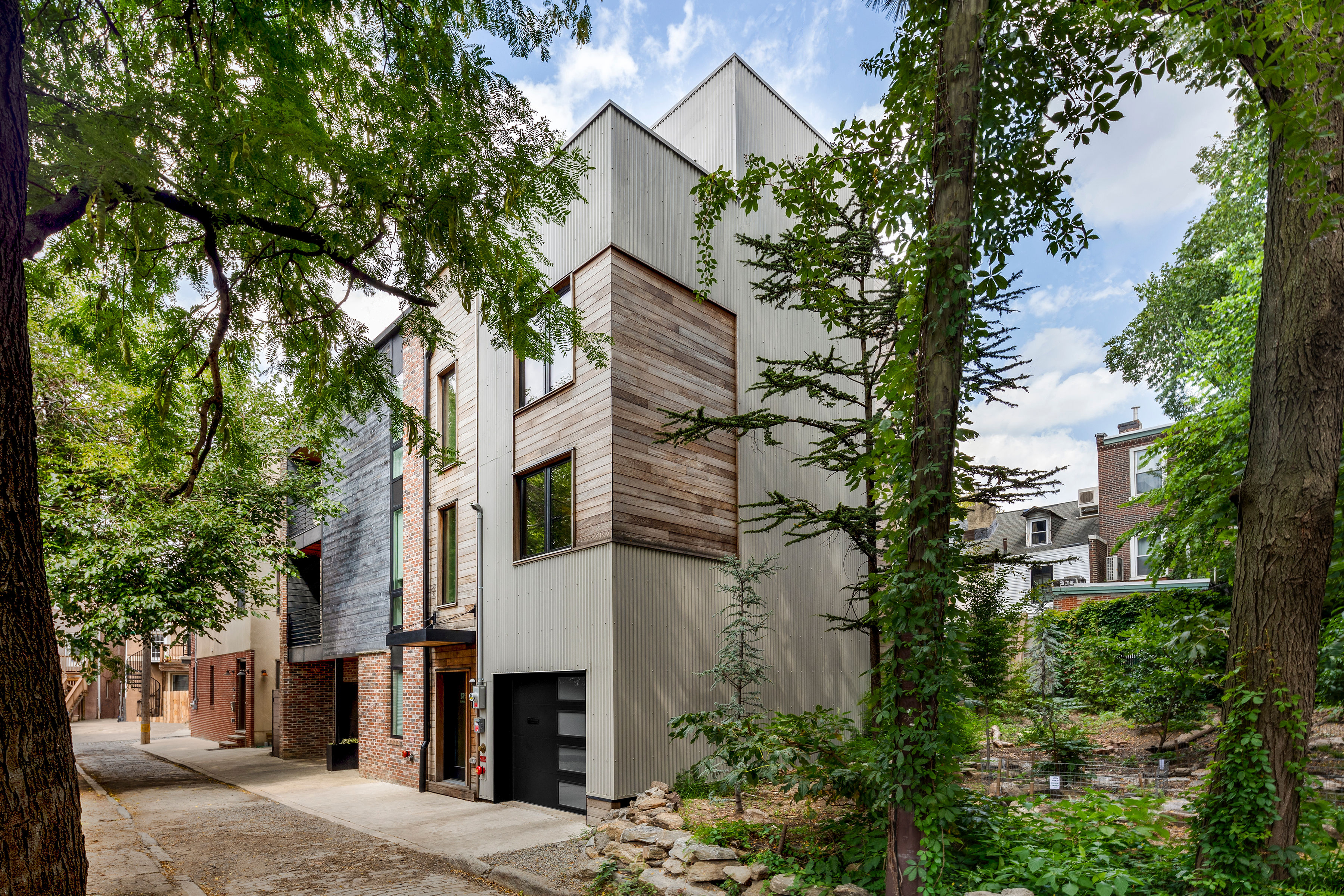
The sustainable building industry often looks at wide open spaces to build their single-family sustainable designs. Large metropolitan areas get their fair share of certified green living spaces, yet most are designed for multi-family residences. Lauren Thomsen Design challenges these notions and builds sustainably in the city of Philadelphia. Despite its 18’ width, the passive rowhouse from Lauren Thomsen Design functions as comfortably as it does sustainably.

Behind the Designer
Lauren Thomsen Design, a full service architectural firm, was founded by Lauren Thomsen, AIA, NCARB, LEED AP. Lauren holds extensive experience with high performance building systems and strategies, complex historic renovations and adaptive reuse projects. The Philadelphia native holds the 2021 PEA Prize from AIA Philadelphia and is an active member of the Carpenters Company of the City and County of Philadelphia and the Philadelphia chapter of the AIA. Her design philosophy is deeply rooted in the commitment the designer has towards their client, “We believe that ‘home’ is a concept that embodies more than space and are passionate about the value of well designed space,” said Thomsen.

Passive Building in Philly
The ambitious project is located in Northern Liberties, a densely populated neighborhood in Philadelphia.
In addition to the small lot size, it has a uniquely urban challenge. The residence is immediately adjacent to a local park, on a largely pedestrian nine foot wide ‘cart street.’ The design team looked to construct a space that solved programmatic requirements, but one that balanced livability with sustainability. The project took nearly three years to complete because of the city’s strict zoning regulations.
With this time, the design team made the decision to set back a portion of the building from the property line. While sacrificing potential interior living space on an already tiny lot, it extends the visual connection to the park and allows for a small terrace. The design decision also mitigates the typical solid ‘party wall’ condition common in Philadelphia row homes. Lauren Thomsen Design took this opportunity to experiment with building materials and paired corrugated metal with locally sourced thermally modified tongue and groove oak siding.

Sustainable Specs
For this project she worked with a Certified Passive House Consultant. The energy modeling was done during the design process in-house. The architects were on site often during construction observing and in close dialogue with the general contractor, a Certified Passive House Builder.
Building to PHIUS standards requires the building envelope to be highly insulated and airtight. As the entire property is only 216” wide, the thickness of the wall assemblies were deeply considered by the design team. The Passive Rowhouse was built with an interior service cavity, as well as 4” of continuous exterior insulation. The amount of glazing was moderated to provide ample daylight, but not allow an excessive amount of solar gain or thermal transmission.
The foundation of the building is poured in place concrete with 3” of continuous exterior EPS insulation on the walls and slab, as well as 3” of continuous EPS and R-10 cavity insulation on the interior of the foundation wall. Aside from a steel moment frame at the garage door, the super structure is conventional wood framing. The home has a 3kw photovoltaic array on the roof and battery storage. An electric car charger, smart energy panel, and home energy automation systems have been installed to allow for source control and continuous monitoring of energy production and utilization.

Certified and Satisfied
The Lauren Thomsen Design team worked with PHIUS to ultimately modify their certification standards to better account for adiabatic party walls in the envelopes of attached single family homes. This paved the way for other urban project teams with similar design ambitions.
At completion the project is total of 1,675 sf of conditioned living space, not including the garage.The three-bedroom and three-bathroom home met the needs of their downsizing client. They desired a minimalistic approach in terms of space and amenities while balancing their requests for a high performance and resilient space. The project also allows for their client to have easy access to their daughter and son-in-law who are immediately adjacent at the rear of the property.
Reflecting on her design experience and this project, “We recognize that our projects are not simply a built output that is designed, constructed and then turned over to a client, ” said Thomsen. “We see our projects as ecosystems that must serve owners and occupants for their entire life cycle and embrace the responsibility to deliver the best possible design solutions accordingly.”
The project was the design team’s first certified passive house. The certification in this location is a testament to the industrious and studious team at Lauren Thomsen Design.
By Sofia Feeney. She is the Editor at Builder Media and can be reached at sofia@builder.media.
This is featured in the November/ December issue of Green Home Builder, read the print version here.


