
Organic Architecture and Precise Building Science
Tom Bassett-Dilley, FAIA, CPHC, LFA, NCARB, founded Tom Bassett-Dilley Architects (TBDA) in 2006 to pursue sustainability by design. His firm’s project, the Lake Bluff Passive House, was recognized by the AIA Chicago chapter with a Decarbonization Citation of Merit.

Early Inspirations
Bassett-Dilley’s entry into architecture was heavily influenced by Frank Lloyd Wright; he spent a year studying at Taliesin West, the Frank Lloyd Wright School of Architecture. His original inspiration is present in the company’s work and philosophy.
The firm is an Architecture 2030 Signatory firm, a challenge issued in 2005 with a framework for all new buildings and major renovations to produce zero carbon emissions. TBDA notes it has met carbon reduction goals portfolio-wide each year since 2018.
Bassett-Dilley became a Certified Passive House Consultant in 2010 and two years later, the firm designed the first-ever Phius-certified project in the Chicago region. Since then, the firm has expanded its portfolio to include projects that have received certifications from Phius, LEED, ILFI Zero Energy, and the Department of Energy Zero Energy Ready Home. TBDA is also committed to sustainable education in building science such as advanced framing, insulated concrete forms, masonry and prefab systems.
“Our design process is a collaboration with owners and consultants, from early hand sketches through detailed 3D design and construction drawings, healthy and efficient component specifications and energy models,” said Bassett-Dilley.
Balancing Design Elements
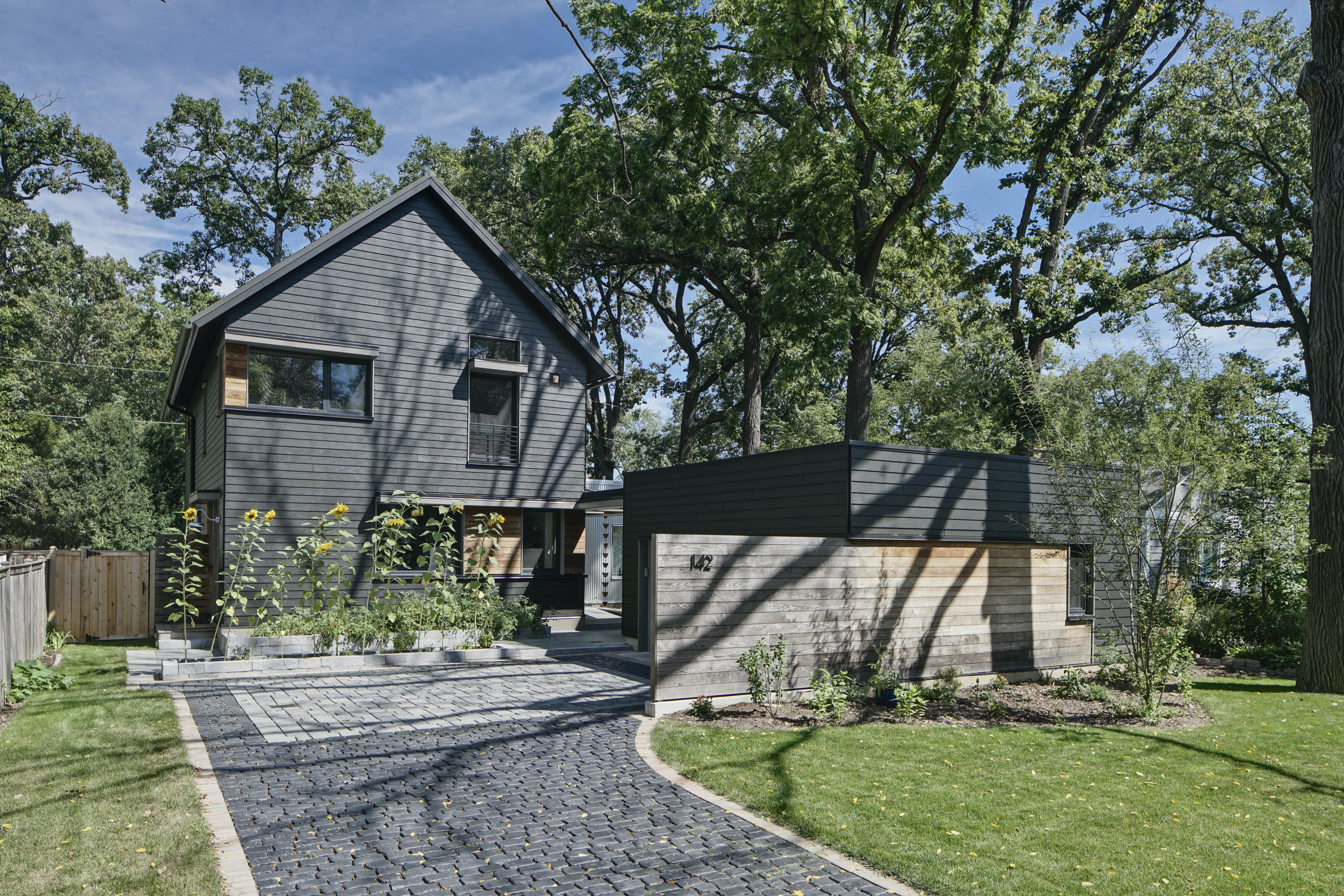
The Lake Bluff Passive House project is located in Lake Bluff, Ill., on the North Shore of Chicago. It was built in collaboration with contractor Biltmore Homes and structural engineer Goodfriend Magruder Structure. The near-retirement homeowners were seeking a home that would incorporate age-in-place features and connectivity to daily amenities. On a narrow south-facing lot with many existing mature trees, the TBDA faced significant design challenges. The design solution was to anchor the garage door as the facade with the main body of the house behind.
As an infill project, the modern design provides a harmonized variance in the traditional landscape by maintaining modern sightlines without compromising livability. The primary bedroom suite was placed as a one-story pavilion with a private courtyard between it and the garage. This design decision marries the needs of the homeowner while also providing dynamic spatial transitions and connectivity to the environment.
“The main stair and upper hall provides a vista over the first floor bedroom suite to a remarkable stand of mature oak trees to the east,” said Bassett-Dilley. “This space brings light deep into the middle of the house and provides a long vista to be enjoyed every day on this otherwise constrained lot.”

Cold-Climate Engineering
As one of the first Phius projects in the area notorious for brutal winters, the Lake Bluff Passive House educated TBDA in best practices for cold-climate heat pump-conditioned homes. Short-ducted systems in the attic and crawlspace advance the home’s indoor air quality with the energy recovery ventilation system independently ducted to provide separate filtration and flow rates. While temperature setpoints can vary by floor, the systems are concealed, extremely quiet and highly efficient.
The energy efficiency begins within the garage with 30-amp EV chargers and continues throughout the home with low-flow water fixtures and a demand-controlled hot water recirculation system. The triple-glazed windows and sliding door serve a dual purpose, contributing to energy performance while guiding in natural light throughout the main floor.
“Our pursuit of Passive House wedded with biophilic design has led to identifying strategies for orchestrating space, light and materials,” said Bassett-Dilley. “In the Lake Bluff Passive House, the enticement and discovery experience of entry is rich with moments of anticipation led by natural light.”
The 3,506-square-foot house’s predicted Energy Use Intensity (EUI) was 5.0 kBtu/sf/yr. For comparison, the average 2,000-square-foot home’s EUI ranges from 30 to 40 kBtu/sf/yr. An estimated 90% savings according to the Architecture 2030 benchmark.
Bassett-Dilley reflected that the Lake Bluff Passive House balances the aim for sustainability and long-term habitability, a demonstration in delivering in building science and aesthetics.
Photo Credit: Eric Hausman
By Sofia Feeney. She is the Editor at Green Home Builder and may be reached at sofia@builder.media.
This story is featured in the read the May/June issue of Green Home Builder, read the print version.


